


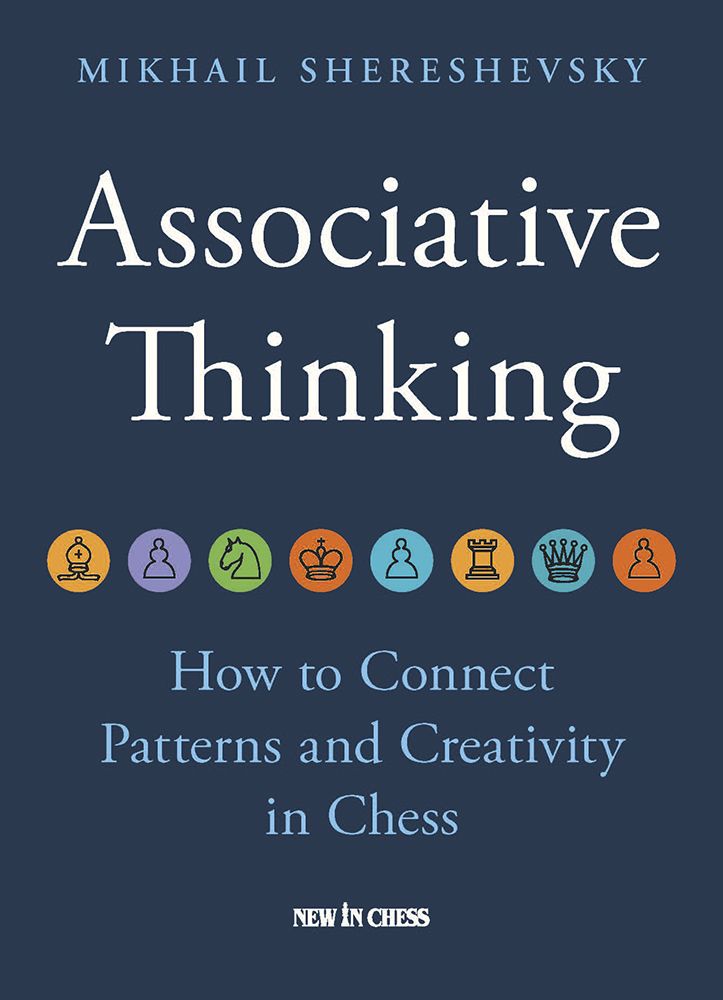
Schereschewski: Associative Thinking (paperback)
Autor: Schereschewski, Michail
Verlag / Hersteller: New in Chess
Erscheinungsjahr: 2025
Sprache: Englisch
Buchumschlag: paperback
Seiten: 304
Build Chess Understanding Through Pattern Recognition and Association
Mikhail Shereshevsky's Associative Thinking addresses a fundamental challenge facing modern players: how to absorb chess knowledge without relying on rote memorization. Rather than accumulating moves mechanically, this approach encourages players to visualize techniques as vivid, memorable patterns.
The book draws on games and analysis from elite grandmasters—Andersson, Karpov, Kramnik, and Carlsen—to demonstrate how associative reasoning shapes decision-making at the board. By studying how past masters solved recurring chess problems, players develop intuition grounded in principle, not memory.
Shereshevsky, author of the widely-praised Endgame Strategy and The Shereshevsky Method to Improve in Chess, applies his proven training philosophy to this deeper exploration of chess learning and mastery.
Highlights
- Move beyond memorization toward pattern-based understanding of chess positions
- Learn how to create lasting mental images of key techniques and positional ideas
- Study annotated games from Andersson, Karpov, Kramnik, and Carlsen to strengthen associative thinking
- Explore fundamental chess questions through concrete examples: knight and pawn interaction, rook placement behind passed pawns, pawn placement in minor-piece endgames
- Apply strategic principles to middle and endgame decisions with greater confidence
A practitioner's guide to building chess understanding that transfers from board to board.
FAQ
What does associative thinking mean in chess, and how is it different from memorization?
Associative thinking involves creating vivid mental images and connections between chess concepts rather than memorizing move sequences. Instead of remembering specific variations, players learn to recognize patterns and principles by studying how great masters handled similar positions. This approach builds intuition that adapts to new situations, whereas memorization becomes useless when the position deviates even slightly.
Which grandmasters' games are featured in the book?
The book emphasizes games and analysis from Ulf Andersson, Anatoly Karpov, Vladimir Kramnik, and Magnus Carlsen. Many examples include original annotations from the players themselves, offering insight into how these champions think through complex positions.
What topics and positions does the book cover?
The book addresses recurring chess problems such as optimal knight-and-pawn coordination, correct rook placement when supporting a passed pawn, and pawn structure when playing bishop against knight. These abstract positional and endgame themes serve as entry points for developing pattern recognition skills.
304 Seiten, kartoniert, 1. Auflage 2025, englisch
Leseprobe
Sichere Zahlungsoptionen bei uns im Shop









-
Versand mit DHL
-
Versandkostenfrei in DE ab €50
-
30 Tage Rückgaberecht