





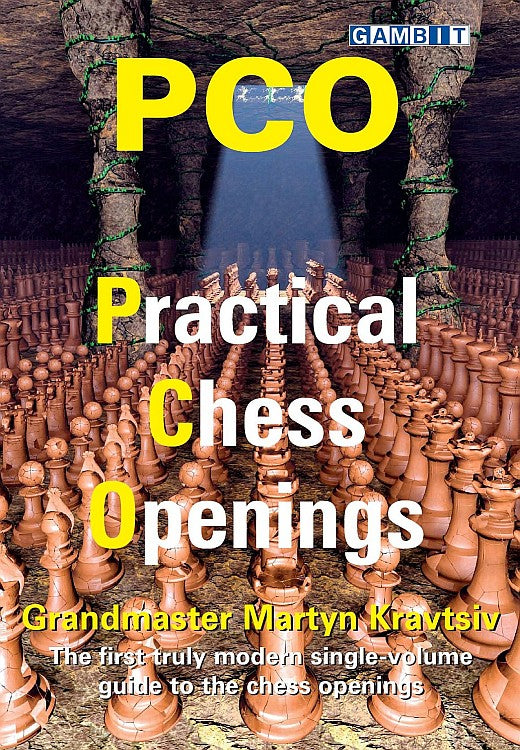
Kravtsiv: PCO: Practical Chess Openings
Autor: Kravtsiv, Martyn
Verlag / Hersteller: Gambit Publications
Erscheinungsjahr: 2025
Sprache: Englisch
Buchumschlag: paperback
Seiten: 544
Modern Opening Theory for the Computer Age
Martyn Kravtsiv's PCO: Practical Chess Openings reflects how opening theory has fundamentally shifted in the 21st century. This 544-page guide departs from older opening literature by embracing computer analysis while prioritizing practical play against human opponents.
The book addresses intermediate to advanced players and trainers who want to understand which lines computers may underestimate but cause real problems over the board. Rather than pursuing theoretical advantage by force, modern players seek flexible repertoires with concrete strategic ideas.
Kravtsiv, a Ukrainian grandmaster and contemporary of Magnus Carlsen, explains which openings deserve serious attention today, which have been analyzed into irrelevance, and which suit rapid chess best. The focus is on positions with genuine practical potential and human-understandable plans.
Highlights
- Covers the full opening spectrum with emphasis on topical lines that computer analysis suggests have lasting value
- Explains why certain traditional openings are no longer recommended rather than cataloguing endless variations
- Explores strategic themes—both classical and contemporary—that give shape to modern opening play
- Identifies which openings work best in rapid chess and what preparation each requires
- Incorporates insights from neural networks and deep computer investigation into practical guidance
- Balances computer evaluation with the realities of human middlegame play
A single-volume opening guide that treats chess theory as it is played today, not as textbooks from previous decades assumed it should be.
FAQ
Does this book cover all openings?
Yes, it covers the full opening spectrum. However, Kravtsiv allocates space based on current relevance and computer assessment. Popular lines with strong futures receive detailed analysis, while openings that have been superseded or analyzed to death are covered more concisely or explained through strategic principles rather than endless variations.
What makes this different from earlier opening manuals?
The book is shaped by 21st-century realities: computer analysis has fundamentally changed which positions players pursue, the rise of flexible repertoires over narrow systems, and the discovery that positions computers may rate as merely equal often cause serious practical problems for human opponents. Kravtsiv writes from this modern perspective rather than inheriting the assumptions of older opening theory.
Is this book suitable for rapid chess preparation?
The book identifies which openings are practical for rapid chess specifically and explains what type of preparation suits each one. However, it is a comprehensive guide to opening theory overall, not a rapid-specialized manual.
Sichere Zahlungsoptionen bei uns im Shop









-
Versand mit DHL
-
Versandkostenfrei in DE ab €50
-
30 Tage Rückgaberecht