


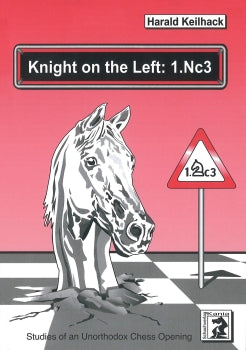
Keilhack: Knight on the Left: 1.[Pferd]c3 - Studies of an Unorthodox Chess Opening
Autor: Keilhack, Harald
Verlag / Hersteller: Kania Verlag
Erscheinungsjahr: 2005
Sprache: Englisch
Buchumschlag: hardcover
Seiten: 383
Master 1.Nc3 – An Underrated Opening with Independent Strategic Value
Knight on the Left by FM Harald Keilhack explores 1.Nc3, a move widely dismissed as a mere transposition tool but which, in fact, offers distinct strategic possibilities and independent opening systems. This comprehensive study proves that 1.Nc3 deserves recognition as a legitimate opening in its own right.
The book addresses the central question facing 1.Nc3 practitioners: when to maintain independent lines and when to transpose to established 1.e4 systems. Rather than limiting White to unconventional play, 1.Nc3 aligns with classical opening principles—development and central control—while offering practical winning chances through knight tactics.
Across 383 pages and 99 model games, Keilhack systematically covers every major defensive setup against 1.Nc3, showing how the move can serve as both a serious opening weapon and a flexible transposition tool.
Highlights
- Complete repertoire coverage: independent lines after 1.Nc3 e5, 1.Nc3 d5, 1.Nc3 c5, 1.Nc3 g6, and other Black responses
- Strategic guidance on critical decision points—when to maintain independent setups versus when to transpose to 1.e4 openings for optimal advantage
- 99 instructive model games demonstrating practical application and tactical patterns typical of 1.Nc3 play
- Special focus on late transpositions (move 6 and beyond) to 1.e4 positions under favorable circumstances
- Anti-Caro-Kann lines and other neglected sidelines often reached via 1.Nc3 in practice
- Flexible approach suitable for transitioning from 1.e4 repertoires gradually into 1.Nc3 systems
An essential reference for players seeking to build a 1.Nc3 repertoire grounded in sound strategy and tactical awareness.
FAQ
What makes 1.Nc3 a viable opening, and how does it differ from other unorthodox first moves?
Unlike 1.b4 or 1.g4, which compromise White's position or restrict strategy, 1.Nc3 aligns with classical opening principles—development and central control of e4 and d5. The book demonstrates that 1.Nc3 offers independent strategic systems alongside the flexibility to transpose to established 1.e4 openings when needed.
How should a 1.Nc3 player decide between maintaining independent lines and transposing to 1.e4 systems?
The book systematically addresses this by analyzing critical positions after Black's major responses (1...e5, 1...d5, 1...c5, 1...g6). Keilhack shows when independent setups offer advantage and when transposing to 1.e4 positions—especially at move 6 or later—serves White's interests better.
Does the book cover obscure lines or focus on main-line theory?
The book covers both: every 1.Nc3 continuation with independent value, plus neglected sidelines (such as anti-Caro-Kann variations via 1.e4 c6 2.Nc3) that occur frequently in practice but are overlooked in standard opening manuals. The emphasis is on practical, playable systems rather than exotic moves.
Sichere Zahlungsoptionen bei uns im Shop









-
Versand mit DHL
-
Versandkostenfrei in DE ab €50
-
30 Tage Rückgaberecht