

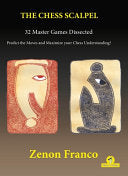
Franco: The Chess Scalpel - 32 Master Games Dissected - Predict the Moves and Maximize Your Chess Understanding
Autor: Zenon Franco
Verlag / Hersteller: Thinkers Publishing
Erscheinungsjahr: 2022
Sprache: Englisch
Seiten: 288
Train Like a Coach: Master Game Analysis Through Move Prediction
The Chess Scalpel by Zenon Franco presents 32 master games designed as interactive training sessions rather than passive reading. The core idea: work through each game as if playing in real time, predicting moves before seeing the solution.
The book combines guess-the-move exercises with strategic and tactical instruction. Each game requires substantial engagement—roughly 90 minutes per session—and rewards correct predictions with points, creating measurable progress while building chess understanding.
This approach works for intermediate players and ambitious amateurs seeking structured calculation training and deeper pattern recognition in real games.
Highlights
- 32 annotated master games structured as interactive coaching sessions
- Guess-the-move format with scoring system to track prediction accuracy
- Strategic analysis covering positional play, tactical motives, attack and defense
- Detailed explanations of the ideas behind each move, not just the notation
- Old-school solving method using paper and pencil for focused concentration
The focus is on effort and learning with every game, not the final score.
FAQ
How does the guess-the-move format work?
For each game, you attempt to predict the next move before revealing the solution. The book includes occasional misleading suggestions to test your concentration. Points are awarded for correct moves and some alternative strong plays, creating a scoring system that reflects how well you would have played.
What chess topics are covered across the 32 games?
The games cover a range of themes: chess calculation, strategy, tactical motifs, attack and defense, positional structures, and endgame play. Rather than isolated positions, these topics emerge naturally from real master games.
What is the recommended way to work through this book?
The author recommends the traditional approach: use a piece of paper to cover the annotations and move solutions, then scroll down the page as you advance through each game. This keeps answers hidden and forces genuine decision-making under realistic conditions.
Sichere Zahlungsoptionen bei uns im Shop









-
Versand mit DHL
-
Versandkostenfrei in DE ab €50
-
30 Tage Rückgaberecht