





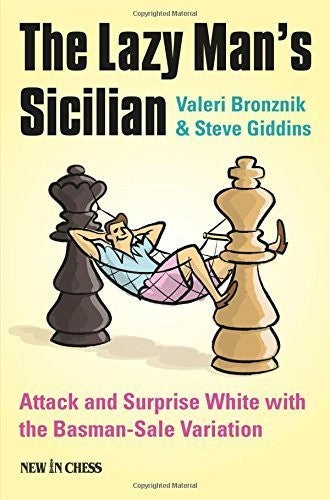
Bronznik/Giddins: The Lazy Man's Sicilian - Attacking White with the Basman-Sale Variation
Autor: Bronznik, Valeri; Giddins, Steve
Verlag / Hersteller: New in Chess
Erscheinungsjahr: 2015
Sprache: Englisch
Seiten: 208
Master an Aggressive Sicilian with Minimal Theory
The Lazy Man's Sicilian by International Master Valeri Bronznik and FIDE Master Steve Giddins introduces club players to the Basman-Sale Variation, a tactical weapon within the popular Sicilian Defence that demands far less memorization than mainstream lines.
This variation surprises opponents while keeping Black's preparation manageable. The authors focus on practical play, pawn structures, and tactical motifs rather than encyclopedic opening theory, making it accessible to players rated 1400 and above.
Rather than requiring hours of theoretical study, this approach rewards understanding and quick adaptation—ideal for ambitious players seeking an effective Sicilian repertoire without the study burden.
Highlights
- Basman-Sale Variation: an underexplored Sicilian line that catches prepared opponents off guard
- Minimal theory requirement: learn key ideas and pawn structures instead of endless variations
- Practical tactical themes: emphasizes combinations and concrete positions over dry analysis
- Designed for club players: suitable from intermediate level (1400+) upwards
- Black plays actively: aggressive counterplay and immediate winning chances from the opening
A refreshingly pragmatic guide to building a fighting Sicilian without drowning in theory.
FAQ
What is the Basman-Sale Variation and why should I play it?
The Basman-Sale Variation is a lesser-known line within the Sicilian Defence that offers Black both surprise value and aggressive counterplay. It requires substantially less theoretical preparation than mainstream Sicilian systems, making it ideal for players who want practical weapons without extensive opening study.
What level of player is this book aimed at?
The book is written for club players rated approximately 1400 to 1900 and above. It assumes some opening knowledge but prioritizes understanding and practical ideas over deep memorization.
Does the book focus on theory or practical play?
The authors emphasize pawn structures and tactical themes alongside opening ideas, providing club players with the understanding needed to navigate positions rather than relying on rote memorization of variations.
Sichere Zahlungsoptionen bei uns im Shop









-
Versand mit DHL
-
Versandkostenfrei in DE ab €50
-
30 Tage Rückgaberecht