


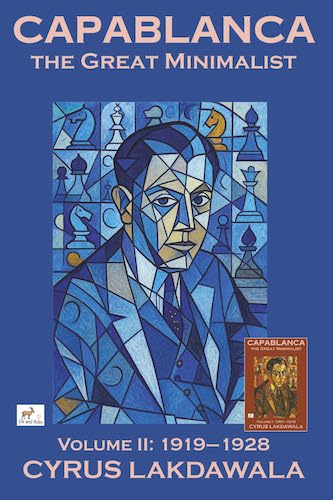
Lakdawala: Capablanca the Great Minimalist – Volume 2: 1919-1928 (paperback)
Autor: Lakdawala, Cyrus
Verlag / Hersteller: Elk and Ruby
Sprache: Englisch
Buchumschlag: paperback
Seiten: 356
Training Strategic Understanding and Combinations Through Capablanca's Games
Capablanca the Great Minimalist, Volume 2: 1919-1928 by Cyrus Lakdawala is a collection of annotated games by José Raúl Capablanca, world champion from 1921 to 1927.
The book is aimed at chess improvers who want to work through concrete positions rather than read about strategy in the abstract.
It covers Capablanca's world championship matches against Emanuel Lasker and Alexander Alekhine, along with tournaments such as Hastings 1919, London 1922 and New York 1924.
The book also includes Moscow 1925, New York 1927 and Bad Kissingen, Budapest and Berlin 1928, with games against Euwe, Tarrasch and Nimzowitsch.
Highlights
- 107 freshly annotated games and fragments
- 103 exercises to solve alongside the games
- Capablanca's approach to planning in quiet middlegame positions
- Short-range combinations and tactical awareness
- Calculation and visualization in concrete positions
- Decision-making from the perspective of a leading strategic player
- Part of a three-volume series, with Volume 1 covering 1901-1918 as a separate book
A practical workbook for readers who want to test their own judgement against one of chess history's most precise players.
FAQ
Which topics does the book cover?
The book covers Capablanca's world championship matches against Lasker and Alekhine, major tournaments from 1919 to 1928, and his strategic and tactical play. The exercises focus on combinations, calculation, planning and decision-making.
Is the book a training resource or only a game collection?
The book combines annotated games with 103 exercises, so it is designed to be worked through actively. It is presented as a training resource for chess improvers.
Does the book belong to a series?
Yes, it is the second of three volumes. Volume 1 covers 1901-1918 and is sold as a separate book.
Sichere Zahlungsoptionen bei uns im Shop









-
Versand mit DHL
-
Versandkostenfrei in DE ab €50
-
30 Tage Rückgaberecht