


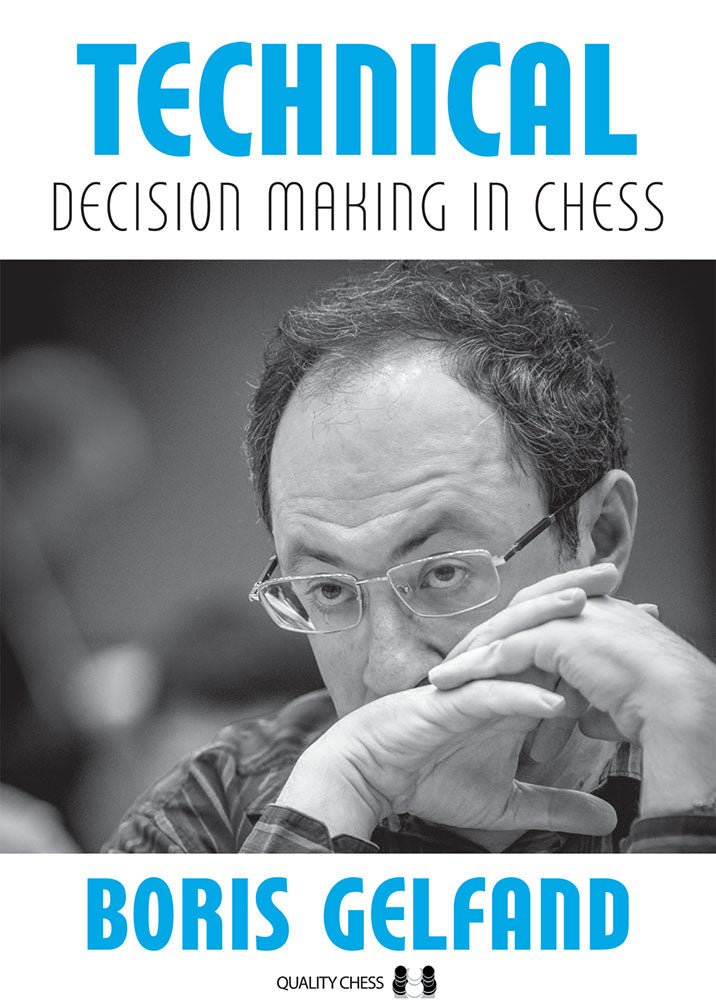
Gelfand: Technical Decision Making in Chess (hardcover)
Autor: Gelfand, Boris; Aagaard, Jacob
Verlag / Hersteller: Quality Chess
Erscheinungsjahr: 2020
Sprache: Englisch
Buchumschlag: hardcover
Seiten: 319
Master Endgame Decision-Making with a Former World Championship Challenger
Technical Decision Making in Chess by Boris Gelfand and Jacob Aagaard explores how elite players evaluate and execute decisions in endgames and technically complex positions. Gelfand, a former World Championship Challenger, shares his systematic approach to navigating positions where structural or material advantage demands precise calculation and judgment.
This book addresses a gap many ambitious players encounter: the ability to convert advantage into victory. Rather than memorized patterns, it teaches the decision-making framework that separates strong players from weaker ones in technical play.
Highlights
- Endgame strategy and decision-making methods from a top grandmaster's perspective
- Core concepts including the Zone of One Mistake to avoid critical errors in technical positions
- Coverage of rook endings, opposite-colored bishop endgames, and structural advantages
- Practical guidance on evaluating and converting material and positional advantages
- Deep study of defensive resources and technical defensive methods in critical positions
For serious players committed to mastering technical endgame play and understanding the decision processes of elite competitors.
FAQ
What exactly is the Zone of One Mistake concept?
Gelfand introduces this as a practical framework for recognizing positions where a single inaccuracy can turn a winning advantage into a drawn or lost game. It helps players identify when precision becomes critical and how to navigate such high-stakes technical positions.
Does the book focus only on pure endgames, or does it cover other positions?
The book concentrates on endgames and technically complex positions where one side holds a structural or material advantage. While these overlap with pure endgame positions, the focus is on positions requiring technical conversion rather than theoretical memorization.
Is this suitable for club players, or is it aimed at very strong players only?
The book is written for serious and improving players willing to study technical positions deeply. It is not an introductory work but rather addresses players seeking to understand how world-class players approach difficult technical decisions.
Sichere Zahlungsoptionen bei uns im Shop









-
Versand mit DHL
-
Versandkostenfrei in DE ab €50
-
30 Tage Rückgaberecht